Arsenal's Mechanism to Overcoming Numerical Inferiority (4v5)
: Securing Vision and Controlling Space within a 1-4-4-2 Defensive Block (vs Man Utd 1-3-4-2-1)
* Date of Analysis: November 30, 2025 (2025/26 Season)
* Subject: Arsenal FC Defensive Tactics (vs Man Utd)
1. Overview
As of the 2025/26 season, Arsenal has established itself as the best defensive team in Europe's top 5 leagues, conceding only 8 goals in 17 official matches (0.47 goals per game). This analysis investigates the tactical mechanism of how Arsenal controlled the opponent's attack against Manchester United's structurally advantageous 1-3-4-2-1 formation without increasing defensive numbers (maintaining a Back 4).
2. Structural Problem: Numerical Inferiority
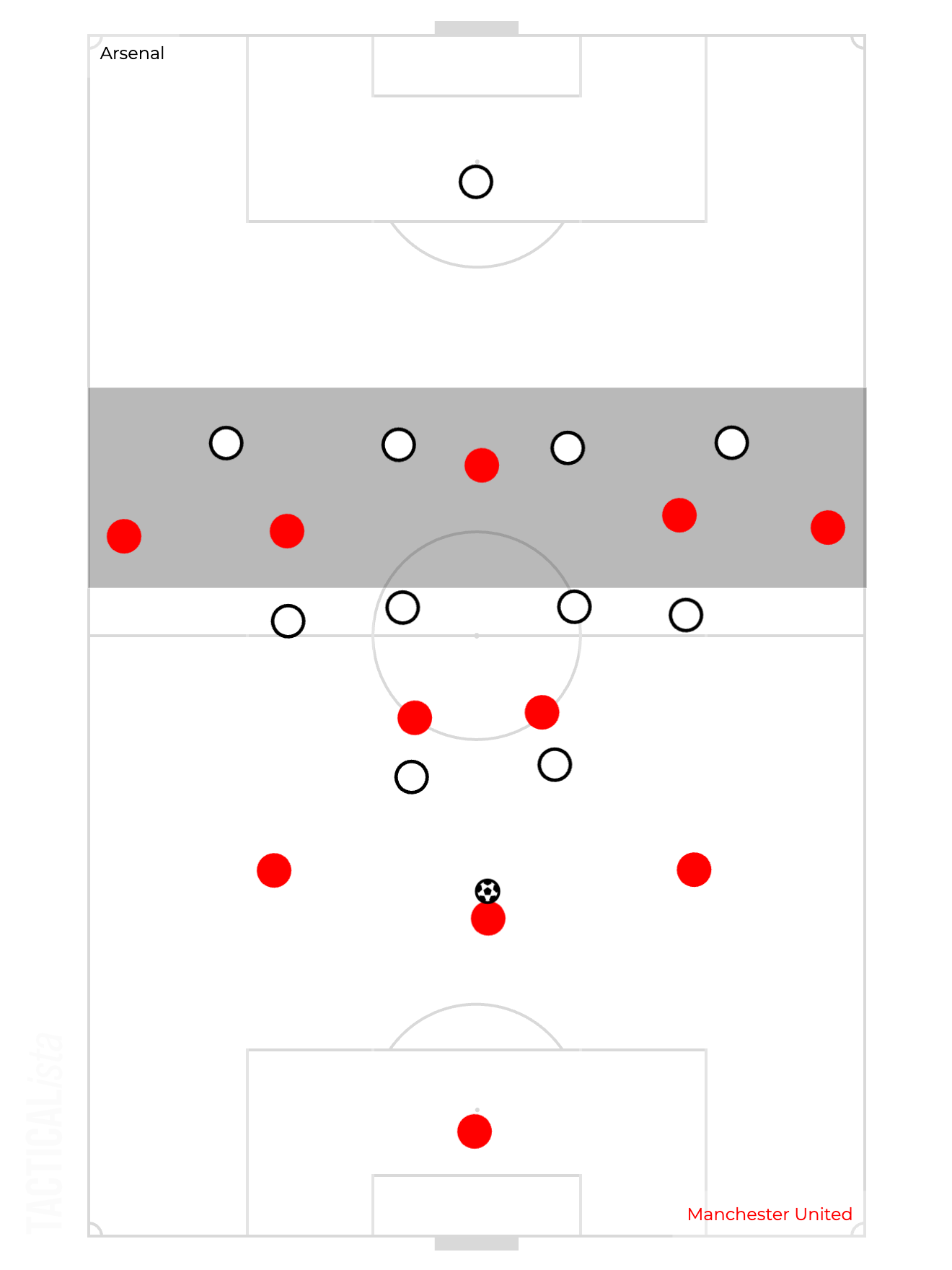
Manchester United's 1-3-4-2-1 system transforms into a 3-2-5 (Front 5) shape during the attacking phase by advancing both wing-backs to the final third. In response, Arsenal maintains a 1-4-4-2 formation, resulting in an inevitable numerical inferiority at the back.
Man Utd Attack: 5 Players (Wing-back – AM – ST – AM – Wing-back)
Arsenal Defense: 4 Players (Back 4)
Result: Creation of a 4v5 Underload for the Arsenal defensive line.
Typically, teams would add a defender (shifting to a Back 5) to match the numbers and lower the defensive line. However, Arsenal chose to maintain the 1-4-4-2 block in the Middle Third.
3. Defensive Mechanism: Controlling Space & Lanes
Arsenal compensated for the lack of 'numbers' by controlling 'space' and 'passing lanes'. This was achieved through the organic movement of the wide midfielders (wingers) and full-backs.
3-1. Winger: Cover Shadow & Channeling
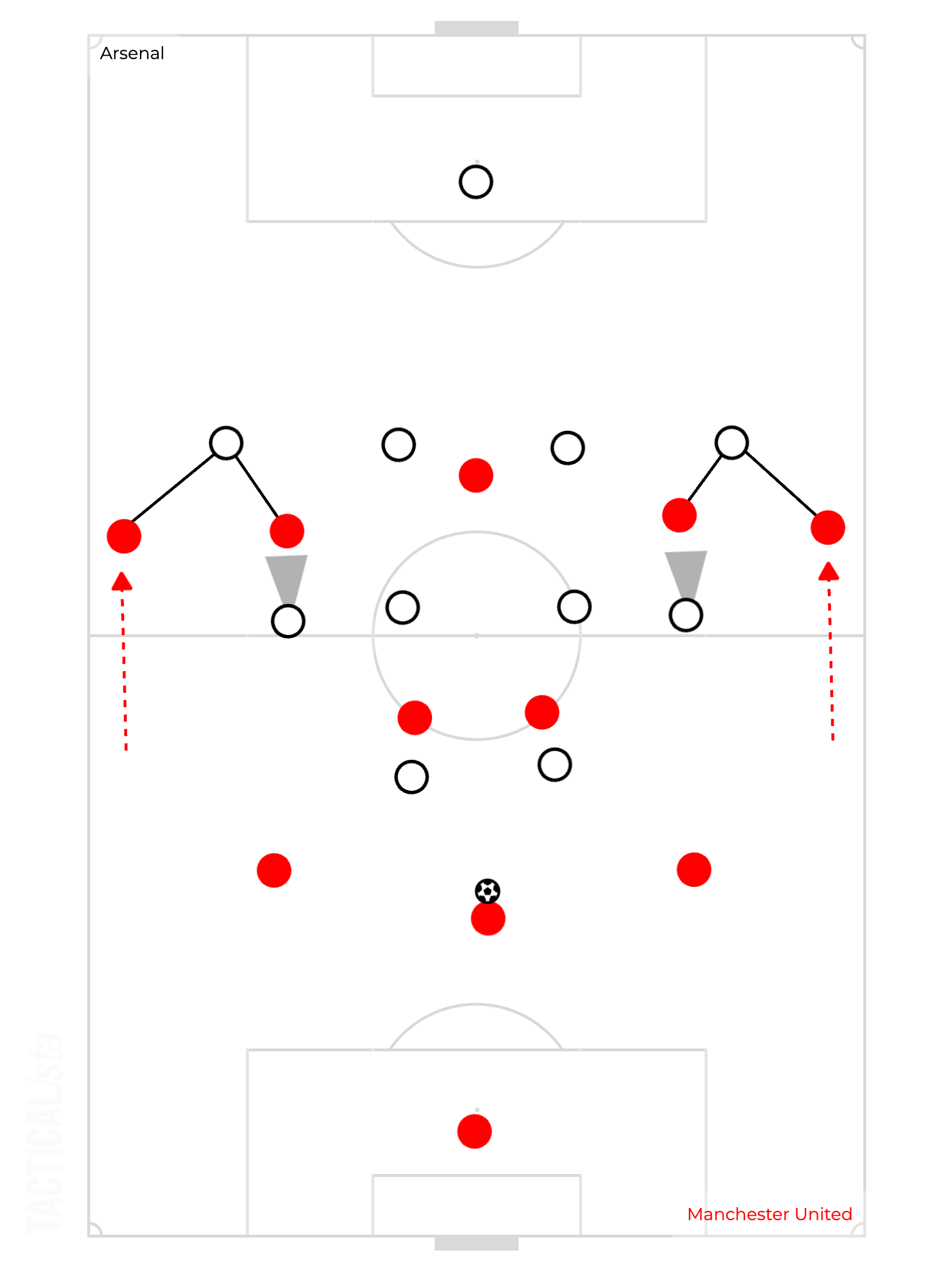
Instead of tracking back to the touchline immediately, the wingers focused on blocking central passing lanes.
Cover Shadow: Positioned narrow to block the passing lane from Man Utd’s backline to their No.10s (Attacking Midfielders) using their body shape.
Pressing Direction: When the wide center-back has the ball, the winger screens the pass to the advanced wing-back while pressing.
Effect: Forcing Man Utd’s build-up into lower wide areas. Compelling the opponent's wing-back to drop deep to receive the ball instead of receiving it in advanced positions.
3-2. Full-back: Positioning based on Triggers
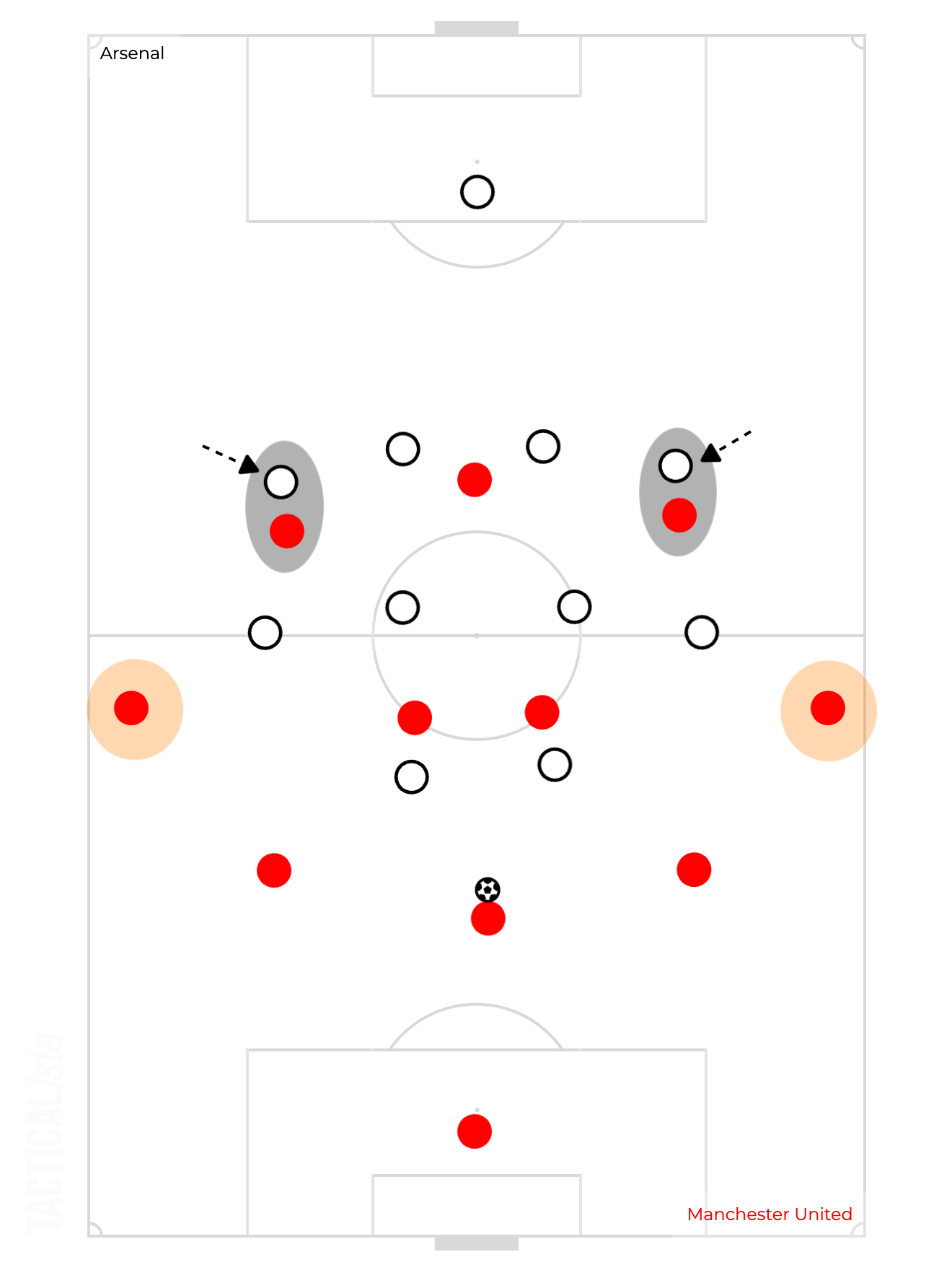
The full-backs adjusted their defensive positioning based on the opponent wing-back's location as a Trigger.
Scenario A (Opponent Wing-back is High): Occupies the 'Intermediate Position' between the No.10 and the wing-back to screen both players simultaneously.
Scenario B (Opponent Wing-back is Low): Aggressively narrows in (Inverted) to Man-mark the No.10 in the half-space.
3-1. Winger: Cover Shadow & Channeling
3-2. Full-back: Positioning based on Triggers
4. Tactical Effect
Forcing the opponent into deep areas without lowering the defensive line provided two clear tactical advantages.
4-1. Securing Field of View & Body Shape
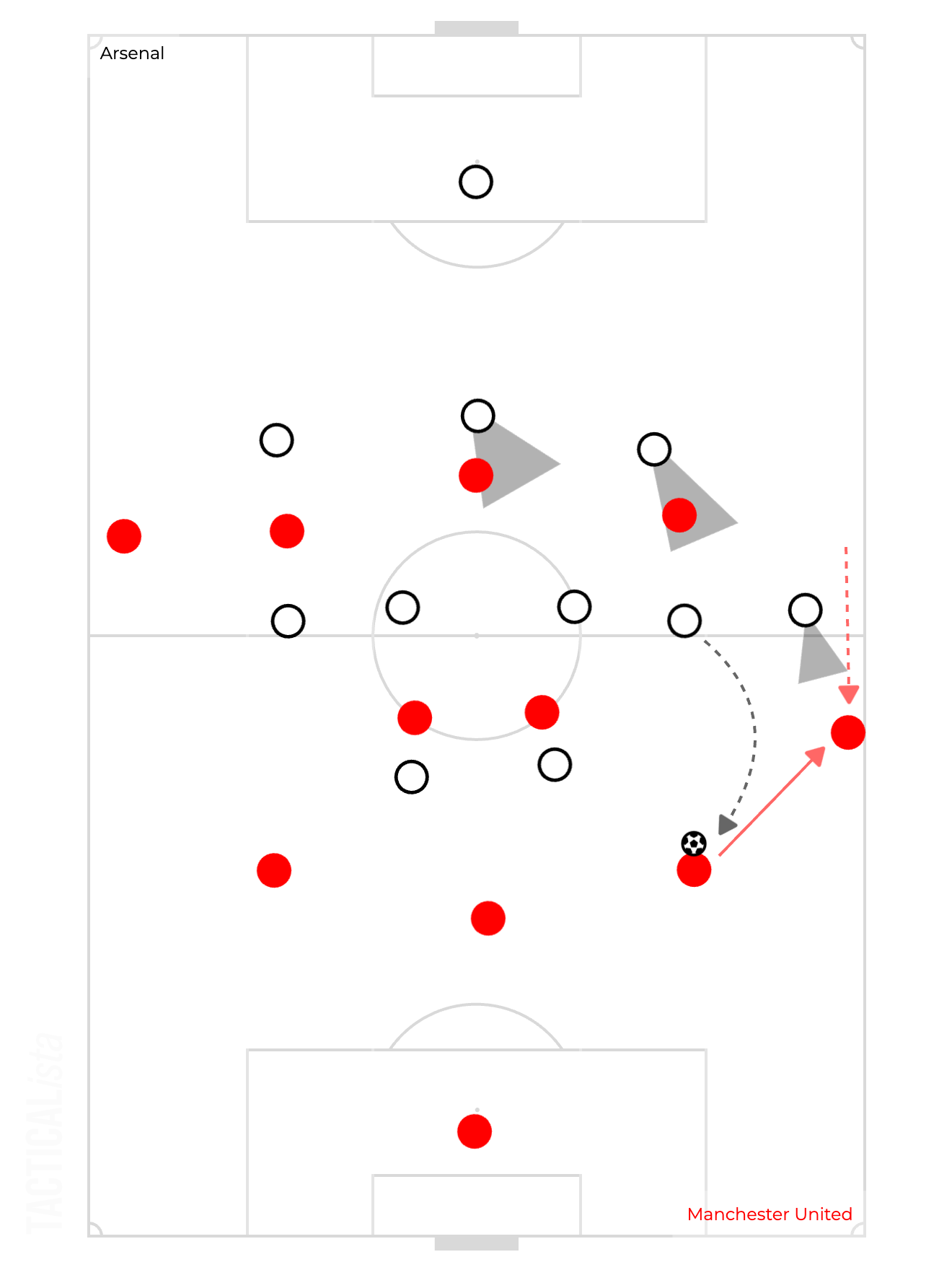
The key to successful defense lies in securing a view of 'both the ball and the player'.
Risk (If opponent receives High): The defender must face the touchline, creating a Blind Side where the infiltrating attacker cannot be seen.
Arsenal's Intent (If opponent receives Low): By forcing the opponent to drop deep, the defender can maintain an 'Open Body Shape' facing forward.
Result: The defender can keep both the ball carrier and the infiltrating runner within a single Field of View, allowing for complete control.
4-2. Transition Efficiency in the Middle Third
This is the offensive advantage gained by maintaining the 1-4-4-2 instead of switching to a Back 5.
Maintaining Attacking Numbers: Since a defender was not added, Arsenal retained sufficient attacking outlets (Front 2 + Wingers).
Central Turnover & Counter: Winning the ball in the central or middle third (rather than deep wide areas) allows for an immediate counter-attack from a closer distance to the goal.

4-1. Securing Field of View & Body Shape
4-1. Securing Field of View & Body Shape

4-2. Transition Efficiency in the Middle Third
5. Conclusion
Arsenal overcame the structural underload of the 1-4-4-2 by utilizing 'Cover Shadows to block passing lanes' and the 'Hybrid Positioning of Full-backs'. Specifically, guiding the opponent to deep areas to secure the defenders' 'Vision' and maximizing counter-attacking efficiency is the core of Arsenal's defensive tactics.
